China has 38 world cultural heritage sites presently, one of which is “Kaiping watchtower and ancient village”. According to official documents, Kaiping watchtower and ancient village has a history of more than 500 years. As a matter of fact, the majority of Kaiping’s watchtowers were built less than 100 years ago. Why is it listed as a world heritage site? Now, starting with its large-scale construction, I will introduce you to the story of Kaiping watchtower, letting you know of its singularity.
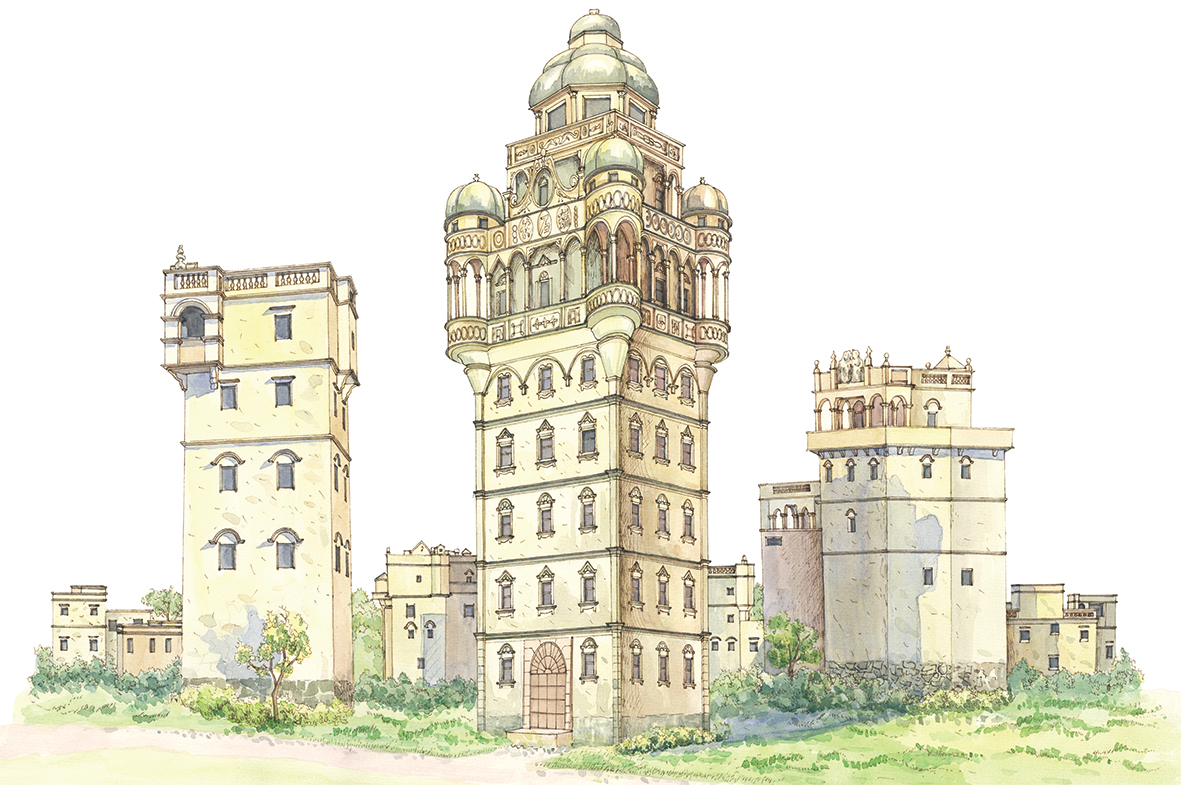
At that time, every large family in Kaiping built at least one watchtower, so there were sometimes several watchtowers in a village.
Before my arrival at Kaiping, which is near Hong Kong, I thought that, because it was located in the south of the Tropic of Cancer, local farmers could harvest rice all year long, and the people could lead a good life. It was not until I got there that I discovered there was a Tanjiang River locally. As a major river in the Pearl River system, it had 3 floodplain events every 4 years on average. In summer, floods often inundate farmlands and villages, so farmers harvest nothing. It even washes down houses and drowns residents. People there never felt safe.
An enticing opportunity presented itself then. In 1865, entrepreneurs came here to recruit labourers to work overseas, promising to take some willing labourers to places where they could earn good money. After hearing the news, young and strong people rushed to the wharf from far and near to learn about the situation. Seeing that some had boarded the ship preparing to set off, many people rushed to sign up.
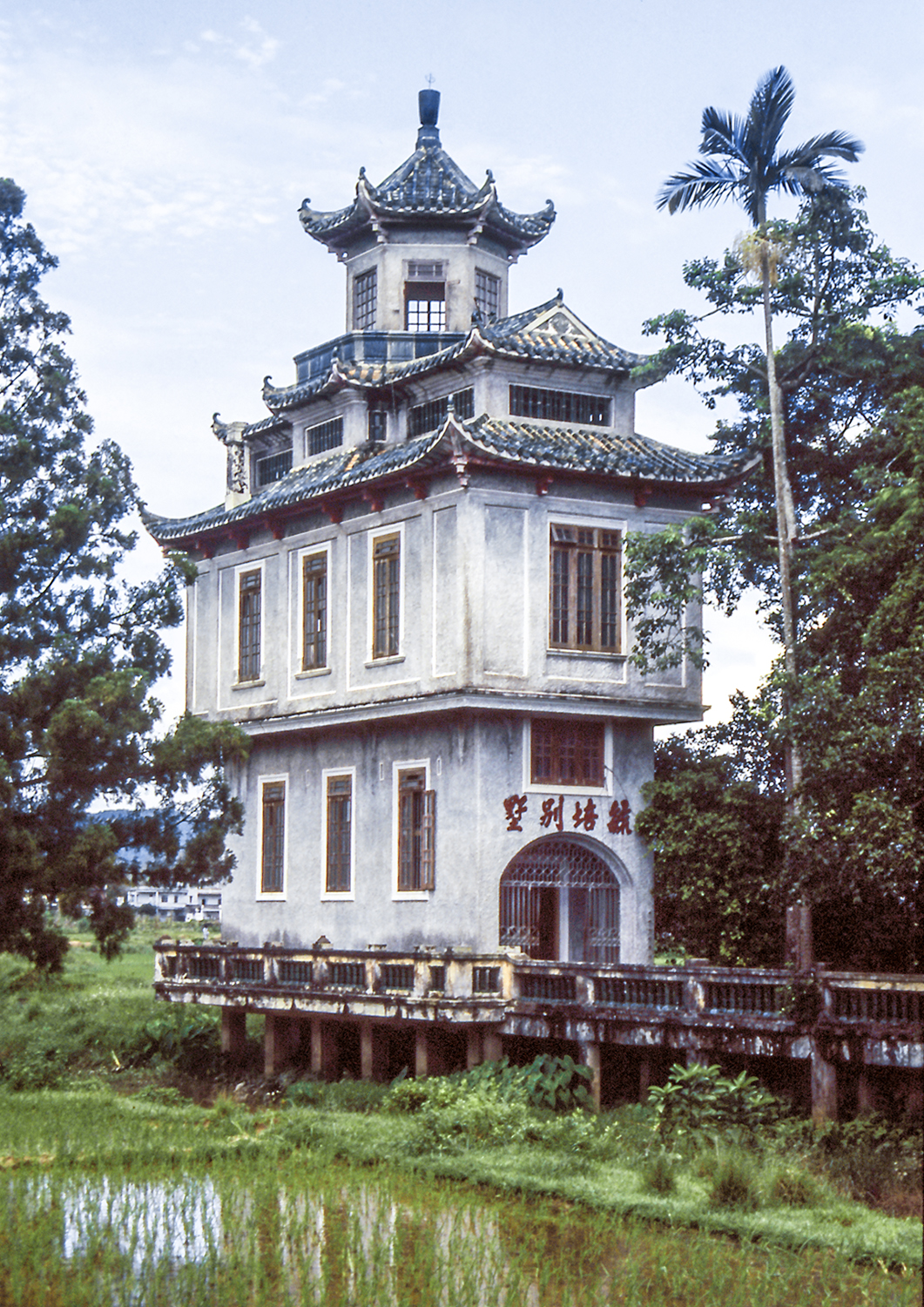
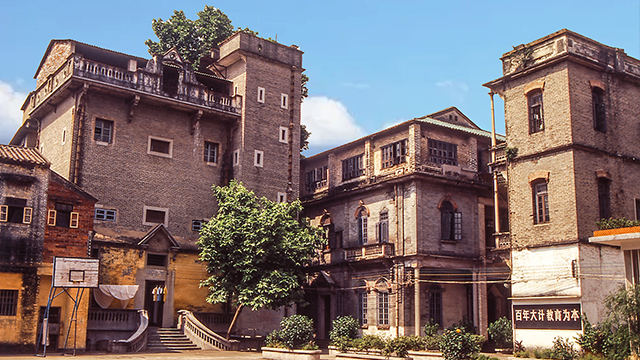
The design of Kaiping Watchtower combines Chinese and European architectural styles. Some watchtowers have traditional Chinese pavilions set up at the top.
More than 15,000 of them went to Vancouver to work on the western section of the trans-Canada East-West Railway contracted by the Central Pacific Railway Company. The railroad traversed the Rocky Mountains with difficult terrain and harsh climate. However, the hardworking Chinese workers enabled smooth progress of the railway construction. With extreme low wage, the Chinese labourers lived frugally and sent money back to Kaiping.
The families of these Chinese labourers received money from overseas, but no sooner had they improved their lives than bandits entered the village at the news and robbed them. This worried many local villagers. How could we ward off bandits? People were reminded of the famous local architectural form of watchtower.
In 1644, a man named Guan Zirui built a completely brick Ruiyun Building in Jingtouli village, Kaiping County, a very strong building. In the flood catastrophe of Tanjiang River Basin in 1884, the nearby villages were flooded, the houses collapsed, and many people were washed away by the flood. The villagers of Sanmenli, Chikan Township, Kaiping County, all survived thanks to a brick watchtower in the village.
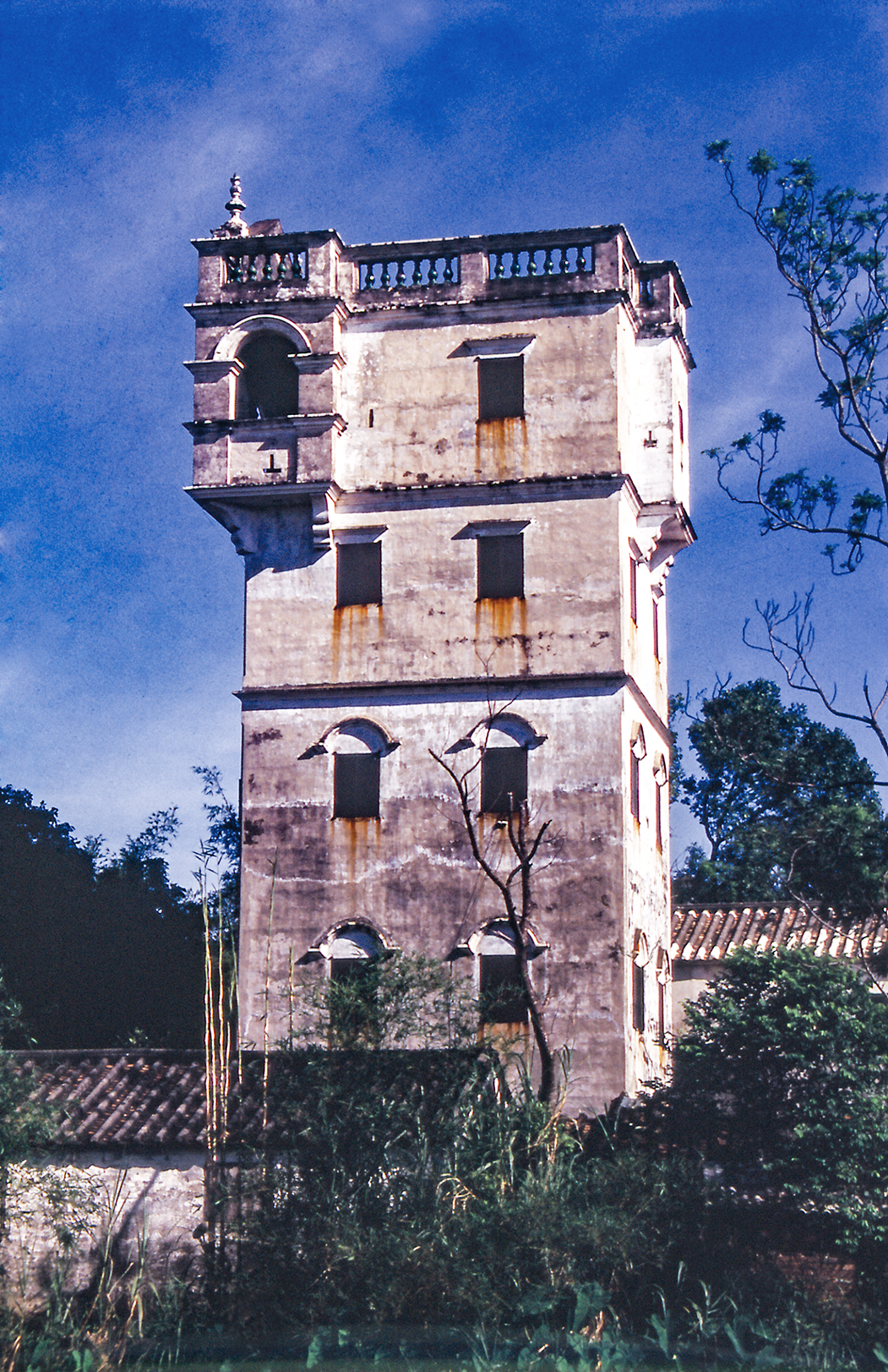
The protruding balcony on the upper part of the Kaiping Fortress building is designed to allow people hiding inside the building to shoot at the invading robbers.
In the early 20th century, some people in Kaiping County began to build watchtowers with reinforced concrete. As high as seven floors, the buildings had a gun hole on each layer, a lookout on top, a machine gun inside with a searchlight on top.
In December 1922, in an attempt to hijack Kaiping Middle School, a group of bandits were illuminated by the watchtower searchlight of Yingcun Village. Some people around took up arms and rescued the principal and 17 students with the help of the light. The event caused a stir in the whole county. Surprised to hear the news, overseas Chinese thought that the watchtower could play a role in preventing bandits. Therefore, the Chinese labourers asked people to design the watchtower drawings in the host countries, and imported cement to build the watchtowers back at home.
In the 1930s, Chinese expatriates in Canada remitted money back home and their relatives in China built over a thousand watchtowers in Kaiping County.
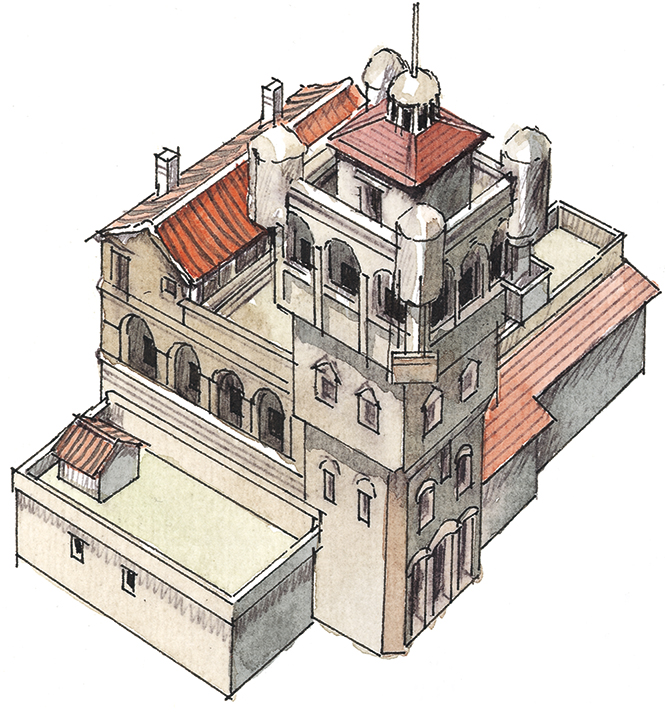
The watchtowers took different forms in my view. Some buildings had four corners on the top with protruding little cylindrical forts, while others had a circle of corridors protruding from the top. Inside the watchtowers, I saw that the defensive installations of the watchtowers were well thought out. For example, the concrete floor of the protruding porch had holes for shooting bandits below. Standing atop the watchtower, one can see far away. Because of the protruding porches or forts at the top of the watchtowers, it was easier to observe and fight the bandits below. There were toilets in the watchtowers, and grain was also stored. In case of danger, one could withstand the siege of bandits for a period of time.
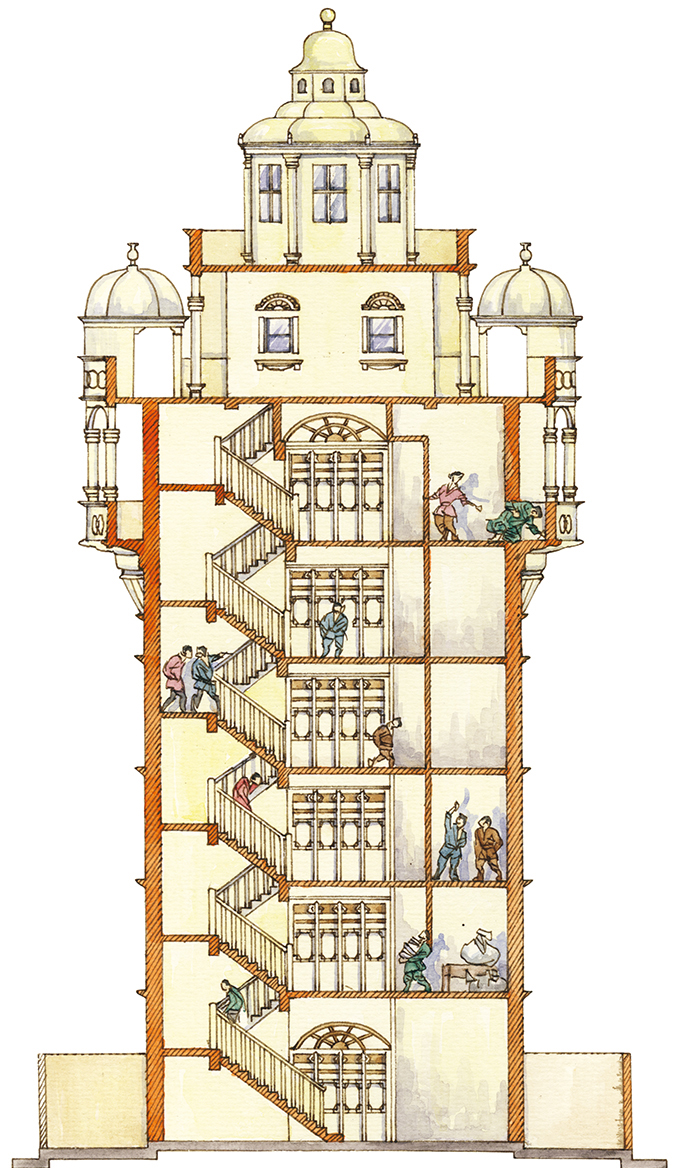
Section of a Kaiping Watchtower
The 1920s were a time of social turbulence. The watchtowers were successfully built to protect the people. Once bandits attacked, the lookout watcher would bang a gong and the surrounding residents would immediately enter the watchtower for shelter. One watchtower could protect dozens of people.
The good protection effect inspired overseas Chinese to return home to build watchtowers. The watchtowers then assumed more diverse shapes, presenting artistic styles mainly about the watchtower top, including Romanesque, Baroque, neo-classical styles and so on. It is not only the youngest folk residential building in China, but also one that adds a miracle to the architectural history of the world. That's why Kaiping watchtower is a world heritage site.
At its peak, Kaiping watchtowers numbered more than 3,000. Watchtowers shaped like a thick pillar placed on the ground were unstable, and some tilted and collapsed when their foundations could not bear them because of the local soft soil. There are 1,833 existing Kaiping watchtowers.
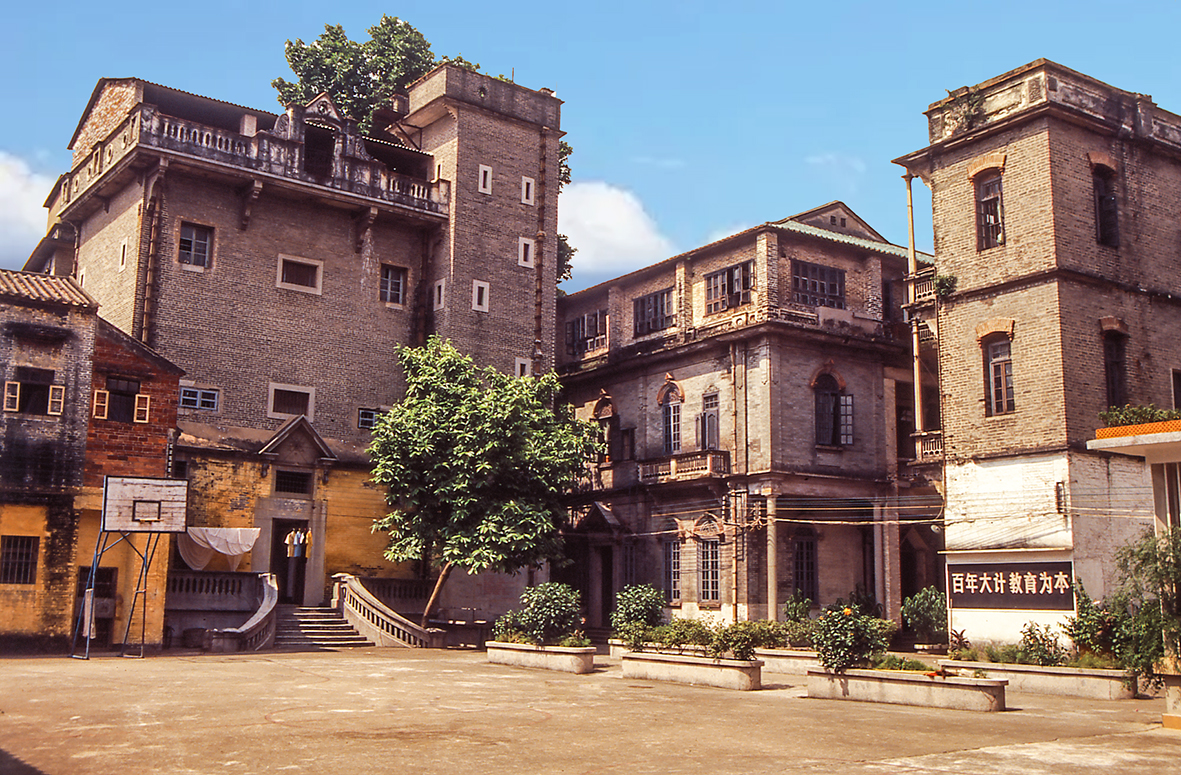
The Kaiping Fortress Building can be organically integrated with residential buildings.
On June 28, 2007, the application for "Kaiping watchtower and ancient village" as a world cultural heritage site was approved at the 31st session of the World Heritage Assembly in New Zealand, and it was officially inscribed on the “World Heritage List”, becoming the 35th world heritage site in China. This gave birth to China's first world heritage item featuring overseas Chinese culture.
Author Profile:
Wang Qijun, Ph.D. in Architectural History, Professor at the Central Academy of Fine Arts in China, renowned painter, Canadian expert invited to work in China